A paper named Computer-Assisted Orientation and Drawing of Archaeological Pottery, written by Wilczek, J., Monna, F., Jébrane, A., Labruère Chazal, C., Navarro, N., Couette, S. and Chateau, C., whose aim is to simplify the routine work of ceramic documentation has been recently published in Journal on Computing and Cultural Heritage.
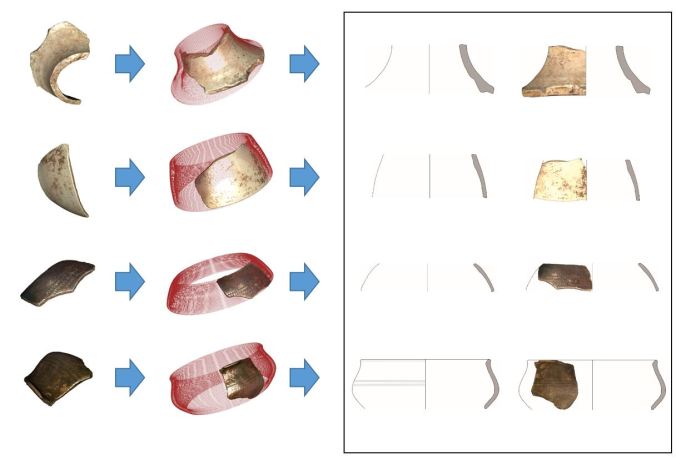
 Archaeologists spend considerable time orienting and drawing ceramic fragments by hand for documentation, to infer their manufacture, the nature of the discovery site and its chronology, and to develop hypotheses about commercial and cultural exchanges, social organisation, resource exploitation, and taphonomic processes. This study presents a survey of existing solutions to the time-consuming problem of orienting and drawing pottery fragments. Orientation is based on the 3D geometry of pottery models, which can now be acquired in minutes with low-cost 3D scanners. Several methods are presented: they are based on normal vectors, or circle fittings, or profile fittings. All these methods seek to determine the optimal position of the rotation axis. We also present and discuss new approaches and improvements to existing methods. We have developed a suite of functions for the computer-assisted orientation and drawing of archaeological pottery. The profile and contours of the fragment, as well as any possible decoration, can be depicted in various ways: photorealistic rendering or dotted patterns, calculated by ambient occlusion, combined or not with artificial light. The general workflow, evaluated using both synthetic and real-world fragments, is rapid, accurate, and reproducible. It drastically reduces the amount of routine work required to document ceramic artefacts. The information produced, together with the 3D representation of the fragments, can easily be archived and/or exchanged within the archaeological community for further research. The source code (built in the R environment), together with an installation notice and examples, is freely downloadable.
See here for more information.
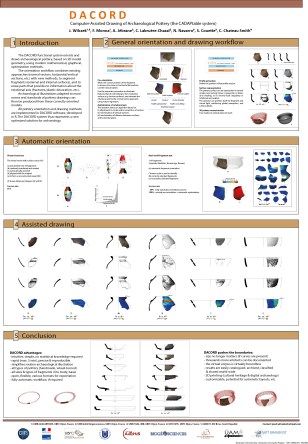 The DACORD functional system, developed within the scope of collaboration between the University of Burgundy (Dijon) and Masaryk University (Brno), orients and draws archaeological pottery, based on 3D model geometry, using modern mathematical, graphical, optimization methods. The orientation workflow combines existing approaches (normal vectors, horizontal / vertical sections, etc.) with new methods, to segment fragments (external and internal surfaces), and to erase parts that provide no information about the rotational axis (fractures, plastic decoration, etc.). Archaeological illustrations adapted to most norms and standards of pottery drawings can then be produced from these correctly oriented models. All pottery orientation and drawing methods are implemented in DACORD software, developed in R.





 jwilczekdotcom